Places
Bermeo Guide: The Basque Fishing Town Next to Gaztelugatxe
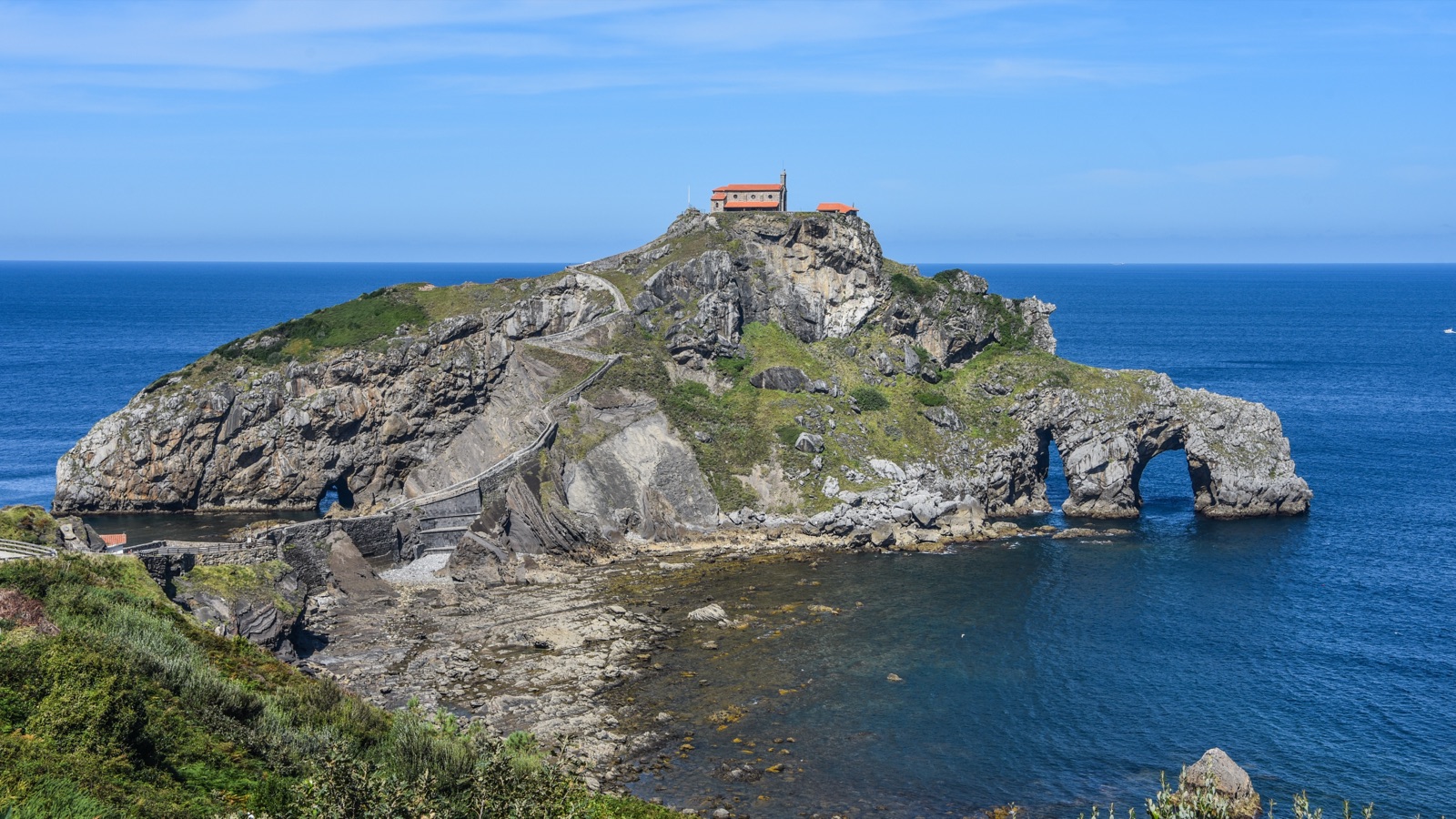
Bermeo is a working fishing town on the Bizkaia coast, and San Juan de Gaztelugatxe belongs to it: the islet and its hermitage are part of Bermeo’s municipality, a short way west along the coast road. The town is 35 km from Bilbao, at the end of Euskotren’s line from Bilbao through Gernika and Mundaka, and bus A3527 links Bilbao, the Gaztelugatxe stop and Bermeo.
It deserves more than a lunch stop. The old harbour is still lined with fishermen’s houses on their medieval plan, a Gothic tower above it holds one of the few museums in the world devoted entirely to Basque fishermen, and the church beside it is where the Lords of Bizkaia swore to respect the local laws. This guide covers what to see, the boat trips to Gaztelugatxe, Mundaka next door, and how to get there.
Bermeo at a glance
- What it is: a fishing town founded in 1239, whose old town is one of the oldest and largest historic quarters in the Basque Country.
- Its link to Gaztelugatxe: the islet belongs to the municipality of Bermeo, and the San Juan gate in the old town was the start of the old road to the hermitage.
- What to see: the old harbour, the Fishermen’s Museum in the Ercilla tower, Santa Eufemia church, the San Juan gate and the San Francisco cloister.
- Getting there: Euskotren’s Urdaibai line (E4) from Bilbao; Bizkaibus A3527 via Mungia, which stops at Gaztelugatxe, or A3515 via Gernika.
- Next door: Mundaka, by bus, train or a footpath of under half an hour.
Bermeo and Gaztelugatxe
Many visitors are surprised that Gaztelugatxe is not a separate place but part of Bermeo. Visit Biscay, the provincial tourism board, notes that San Juan de Gaztelugatxe belongs to the municipality of Bermeo and is one of the gateways to the Urdaibai Biosphere Reserve.
The connection runs deep. In 1334, during the siege of Gaztelugatxe, Alfonso XI ordered Bermeo to be enclosed by a wall. The only gate of that wall still standing, the San Juan gate at the north of the old town, was the starting point of the old road to the hermitage.
Local legend says St John the Baptist walked from the port of Bermeo to the hermitage in three steps, leaving a footprint each time. The first can be seen under the arch of the San Juan gate. It is the easiest piece of Gaztelugatxe folklore to find without climbing anything.
A few metres from the gate, the Centro Gaztelugatxe interpretation centre presents the Natural Monument’s nature, history and traditions, from the bird sanctuary on Akatx island to the kelp forests off the coast. Bermeo’s tourism site lists its opening season as 23 June to 30 September, closed on Mondays and on 9 September, so check the dates before you plan around it.
The old harbour
Portu Zaharra, the Old Port, is Bermeo’s traditional fishing harbour and the heart of the town. The fishermen’s houses around it keep their medieval layout and form, packed tightly between the water and the hill.
This is not a museum piece. Bermeo’s port has worked as a commercial and fishing port since the Middle Ages and today holds the most important inshore fleet on the whole Cantabrian coast; Euskotren’s route guide calls it the largest. Visit Biscay adds that you can visit some of the town’s canneries and see the net-menders of the fishermen’s guild, a reminder that fishing here is an industry, not a backdrop.
For the best overview, climb to the Gaztelu viewpoint above the harbour mouth. From there you can see Bermeo’s three ports, the old, the fishing and the commercial, and facing you the Wave sculpture by the Bermeo sculptor Néstor Basterretxea. One way up is from behind Santa Eufemia church, past the little square beside it.
At the end of the old harbour, the breakwater runs out into the bay towards the island of Izaro. It is an easy walk with the sea on both sides and the town behind you.
Arrantzaleen Museoa: the Fishermen’s Museum
Above the old harbour stands the Ercilla tower, a building from the last years of the fifteenth century and the only tower still standing in the old town. Despite its defensive features it seems to have been built as a home. It was the seat of a merchant family that produced Fortún García de Ercilla and Alonso de Ercilla, author of the epic poem La Araucana. The tower was declared a National Monument in 1943, and since 1948 it has housed the Arrantzaleen Museoa, the Fishermen’s Museum.
The provincial council’s Bizkaikoa page describes it as one of the few museums in the world devoted exclusively to the life and work of Basque fishermen: their customs, their guilds, their boats, and the techniques they used to catch and sell fish. It also tells the story of the Basque Auxiliary Navy, whose core was made up of Basque fishermen.
Practical details, from the Bizkaikoa page:
- Tuesday to Saturday: 10:00–16:00 in winter (January to March and October to December), 10:00–19:00 in summer (April to September).
- Sundays and public holidays: 10:30–14:30.
- Closed: on Mondays, and on 1 and 6 January, 9 September and 25 December.
- Admission: €5, reduced €3; free for everyone on Saturdays and for under-16s.
The two public sources disagree here. Bermeo town council’s page lists split morning and afternoon hours and lower prices, while the figures above follow the provincial council’s Bizkaikoa page. Check before you go, especially if you plan to arrive around lunchtime.
Santa Eufemia and the oath of the fueros
Just above the old harbour stands Santa Eufemia, the oldest church in Bermeo. It was probably built in the thirteenth century and rebuilt at the end of the fifteenth, and it is Gothic, as its windows, doorways and vault ribs show. Its tower, built in 1783, has a dome decorated with pinnacles, and beside the second chapel is the tomb of the Mendoza family in flamboyant Gothic style.
Its importance is political as much as religious. Santa Eufemia was an oath church: the Lords of Bizkaia swore to uphold the fueros, the traditional laws of Bizkaia, here. Bermeo’s tourist office says the oath is depicted in one of the church’s south-facing stained-glass windows. The church was declared a Historic-Artistic Monument in 1995, and Spain’s tourism board still calls it the “Juradera”, the oath church.
If you continue to Gernika later in the day, you will see the other end of the same story: the Tree of Gernika and the Casa de Juntas, where the towns of Bizkaia met from at least the fourteenth century.
The walls, the San Juan gate and the old town
Bermeo was founded as a town in 1239, and its old town is one of the oldest and largest historic quarters in the Basque Country. After Alfonso XI’s order of 1334, the wall appears to have been finished by 1357. Only the San Juan gate survives; all the others were demolished during the nineteenth century. Visit Biscay describes the fourteenth-century San Juan arch as the only one left of the seven gates in the wall.
A walk through the old town takes in:
- The San Juan gate, the fourteenth-century arch where the old road to Gaztelugatxe began, with the saint’s first footprint beneath it.
- Santa María church, one of the most significant works of neoclassical architecture in Bizkaia.
- The town hall, with two sundials on its façade.
- The San Francisco convent, founded by Count Tello and Juana de Lara, lords of Bizkaia, on 30 January 1357, and the oldest convent in Bizkaia. The municipal market occupied its cloister from 1928 until the restoration of 1994, and the church, built in the sixteenth century, is in the Gothic style of the Catholic Monarchs.
Visit Biscay sums up the character of the place: the poorer houses of fishermen and guild workers stood beside the solid walls of the nobility’s towers.
Don’t look for the whaling ship
Older guides to Bermeo mention the Aita Guria, a replica whaling ship in the port that served as an interpretation centre. It is gone. The project started in 2003 and the ship was launched in 2006, but the town council found its upkeep unsustainable, and Deia reported on 10 April 2021 that dismantling had begun and could be finished within two weeks. If a website or guidebook still lists it, treat its other details with caution too.
Boat trips from Bermeo
Bermeo is the port for seeing Gaztelugatxe from the sea. Hegaluze runs scheduled trips from the marina, at the entrance to La Ola car park:
- The Gaztelugatxe route passes Cape Matxitxako and Akatz rock on the way to San Juan de Gaztelugatxe and back, from March to October, and lasts 1 hour.
- The Ogoño route heads the other way, past Izaro island to the Ogoño caves, Elantxobe and Mundaka, from April to October.
- Cetacean-watching trips with the Ekoetxea Urdaibai centre run on Saturdays from April to October, at €45 for adults and €32 for children aged 7 to 12.
In bad weather the operator sends a cancellation message as early as possible, so keep a back-up plan. The boat does not land you on the islet: it shows you the cliffs, the arches and the hermitage from below, a view that people on the steps never get.
Viewpoints around Bermeo
- Cape Matxitxako, the northernmost point of the Basque coast, with an old and a new lighthouse, and a fine spot for watching seabirds and cetaceans. It lies between Bermeo and Gaztelugatxe.
- Tala park, high above the town, looking over the bay to Izaro.
- The breakwater, at the end of the old harbour.
- Gaztelu, above the harbour mouth, for the three ports.
- Sollube, a 684 m summit and one of five Bizkaian mountains once used to summon the towns’ representatives to the assemblies at Gernika, with horns by day and bonfires by night.
Izaro, the island you keep seeing offshore, is uninhabited today. According to Euskotren’s guide to the line, it housed a Franciscan convent until Sir Francis Drake destroyed it in the sixteenth century.
Mundaka next door
Mundaka sits at the mouth of the Urdaibai estuary, just along the coast from Bermeo, and the two combine naturally. From Bermeo there are buses and trains every half hour, and a footpath gets you there in under half an hour.
Mundaka is famous among surfers for its long left-hand wave, which Euskotren calls the best left-hand wave in Europe. Even if you never touch a board, the village is worth a stroll: the harbour, the narrow streets and the hermitage of Santa Catalina on a small promontory by the sea, a little way from the centre. Mundaka’s carnival is one of the oldest in the Basque Country and the festival that draws the most visitors.
Both towns lie inside the Urdaibai Biosphere Reserve, designated by UNESCO in 1984, which Bermeo shares with 22 other municipalities. Around Mundaka it is a landscape of wide marshes and 12 km of sandbanks that shelter thousands of migrating birds. Our guide to day trips along the Basque coast shows how Bermeo, Mundaka and Gernika fit into one day.
Getting to Bermeo
By train. Euskotren’s Bilbao–Bermeo line, the Urdaibai line (E4), runs from Bilbao through Gernika and Mundaka to Bermeo. Between Mundaka and Bermeo it leaves the estuary and runs along cliffs above the Cantabrian Sea, a scenic stretch of line. From Bermeo, Gernika is 20 minutes by train.
By bus. Bizkaibus A3527 runs Bermeo–Mungia–Bilbao by motorway and stops at San Juan de Gaztelugatxe; A3515 runs Bermeo–Amorebieta–Gernika–Bilbao. For Bakio, take A3517 in summer or A3524 in winter.
By car. The BI-631 comes from Bilbao via Mungia, the BI-2235 from Gernika and the BI-3101 from Bakio, passing above Gaztelugatxe. Bermeo is 35 km from Bilbao, 27 km from Bilbao airport and 109 km from San Sebastián.
Timetables change by season, so check them before you travel.
Bermeo as a base for Gaztelugatxe
Starting from Bermeo solves the main problem of a Gaztelugatxe visit: parking. The provincial council notes that the car parks by the islet are usually full between 10:00 and 16:00 and recommends leaving the car in Bakio or Bermeo and taking the bus. Bus A3527 connects Bermeo with the islet, and at Easter and in July and August there are bus visits to Gaztelugatxe with an accompanying tourist guide.
Remember the ticket. On controlled-access days you need a free ticket booked online, and the daily cap is 1,462 people; on other days access is free with no booking. Bermeo’s tourism site puts the walk itself at about 1 hour 30 minutes and does not recommend it for people with heart or breathing problems or reduced mobility. Our guide to getting to Gaztelugatxe has the full details.
Dates to know
A few dates in Bermeo’s calendar affect a visit, in both directions.
- Gaztelugatxe’s local days. The provincial council reserves 24 June, 31 July, 29 August, 31 August and 30 December at Gaztelugatxe for local celebrations and asks tourists not to visit the islet on those days. They are days of local celebration, not for sightseeing.
- 9 September. A local holiday in Bermeo: the Fishermen’s Museum and the Centro Gaztelugatxe are both closed.
- Mondays. The museum is closed every Monday, and so is the interpretation centre in its summer season, so a Monday is better spent on the coast, on the boat or in Mundaka.
- Saturdays. Entry to the Fishermen’s Museum is free for everyone, which makes it a good day for the town itself.
A day in Bermeo
- Morning: Gaztelugatxe first, before the car parks fill; take bus A3527 or drive the BI-3101.
- Late morning: back to Bermeo. Walk in through the San Juan gate and look for the footprint.
- Lunch: around the old harbour.
- Afternoon: the Fishermen’s Museum in the Ercilla tower, Santa Eufemia, then up to the Gaztelu viewpoint.
- Late afternoon: the boat to Gaztelugatxe in season, or the footpath or train to Mundaka.
Several guided day trips from Bilbao include Bermeo. The tour with time for the steps continues to Bermeo and Gernika after two free hours at the islet, and the full day with txakoli stops at Bermeo, Mundaka and Gernika. The tours page compares them.
Frequently asked questions
Is Gaztelugatxe part of Bermeo?
Yes. San Juan de Gaztelugatxe belongs to the municipality of Bermeo, and the old road to the hermitage started at Bermeo’s San Juan gate, where legend places the first of the saint’s three footprints.
How do I get from Bermeo to Gaztelugatxe?
Bizkaibus A3527 links Bermeo with the Gaztelugatxe stop on its way to Bilbao. By car, follow the BI-3101 towards Bakio. From March to October, Hegaluze boats also sail from Bermeo to see the islet from the sea, though they do not land.
Is Bermeo worth visiting?
Yes, especially after Gaztelugatxe. The old harbour, the Fishermen’s Museum in the Ercilla tower and Santa Eufemia church make a rewarding half day, and Mundaka is next door.
When is the Fishermen’s Museum open?
According to the Bizkaikoa page, Tuesday to Saturday 10:00–16:00 in winter and 10:00–19:00 from April to September, with shorter hours on Sundays and holidays. It is closed on Mondays and free on Saturdays; the town council lists different times, so check before you go.
Can I get to Bermeo by train?
Yes. Euskotren’s Urdaibai line (E4) runs from Bilbao through Gernika and Mundaka to Bermeo, and Gernika is 20 minutes away by train.
How far is Mundaka from Bermeo?
Close enough to walk: a footpath gets you there in under half an hour, and buses and trains run every half hour.